

TMS Transportation & Climate Change Conference 2026 will be held on 24 September 2026 at Hilton Yas Island, Abu Dhabi, United Arab Emirates
Conqueror Freight Network is pleased to announce its partnership with The Maritime Standard Transportation & Climate Change Conference 2026, a global industry platform bringing together leaders from transportation, maritime, energy, finance, technology, and government to address the practical challenges of building a more sustainable and resilient transport sector.
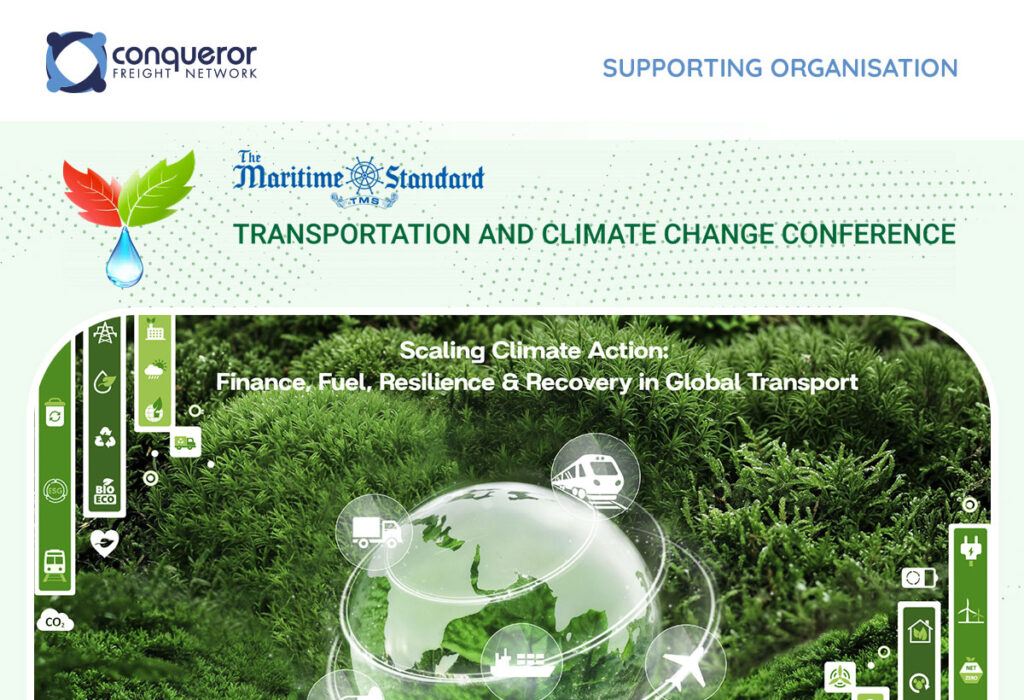
Held under the theme Scaling Climate Action: Finance, Fuel, Resilience & Recovery in Global Transport, TMS TACCC 2026 will examine how finance, alternative fuels, infrastructure development, and digital transformation can accelerate the transition towards a sustainable and future-ready transport ecosystem.
The conference will bring together policymakers, shipowners, port authorities, energy producers, financiers, technology leaders, and legal experts to discuss the evolving regulatory landscape, carbon markets, alternative fuel pathways, maritime decarbonisation, and the investment challenges associated with the transition to net-zero transport.
Key Industry Discussions
The 2026 programme has been developed against a rapidly changing global backdrop, with evolving regulatory frameworks, increasing carbon pricing pressures, alternative fuel development, geopolitical disruption and growing concerns around energy security and supply chain resilience influencing investment and strategic decision-making across the transport sector. The conference will examine how the industry can move from climate ambition towards real-world implementation by bringing together perspectives from across the maritime, transport, energy, infrastructure, finance and technology sectors.
The First Session
The first session, “Delivering Net-Zero Maritime: Regulation, Markets & Investment Readiness,” will focus on the regulatory, financial and commercial forces shaping maritime decarbonisation.
Discussions will examine the latest developments in the IMO’s global GHG regulatory framework, including the proposed fuel standard, GHG pricing mechanism, lifecycle emissions, chain of custody and compliance requirements. The session will also assess the implications of regional regulatory frameworks such as EU ETS and FuelEU Maritime, as well as the growing complexity created by overlapping international and regional climate policies.
Furthermore, this session will explore the implications of regulatory divergence for competitiveness, investment certainty and long-term industry strategy. The financing of maritime decarbonisation will form another key area of discussion, with attention to green and transition finance, blended finance, insurance, public-private partnerships and multilateral support.
The programme will also take a practical look at alternative fuels, examining the availability, cost, infrastructure requirements, lifecycle emissions, safety and scalability of ammonia, methanol, LNG, hydrogen and biofuels. It will conclude by examining geopolitics, energy security and maritime resilience, exploring how disruption around critical maritime chokepoints is affecting energy flows, shipping routes, freight economics, insurance costs, emissions, infrastructure priorities and long-term investment strategies.
The Second Session
The second session, “Technology & Infrastructure: Scaling Decarbonized Transport Ecosystems,” will turn its focus towards the technologies, infrastructure and integrated systems required to move decarbonisation from pilot projects to large-scale implementation. The session will explore how advanced analytics, automation and digital tools can improve routing, reduce emissions and enhance operational performance across fleets and ports. Moreover, it will also examine the role of digital measurement, reporting and verification systems, blockchain and transparent carbon accounting in strengthening emissions tracking, compliance and accountability.
The transformation of ports will be another central theme, with discussions focusing on the development of Green Ports as integrated energy hubs equipped with shore power, alternative fuel bunkering, storage and grid connectivity. As the availability of alternative fuels remains a key challenge for the transition, the programme will examine the requirements for industrial-scale fuel production and logistics, including global distribution networks, certification frameworks and cross-border collaboration to bridge the gap between supply and demand.
Attention will further turn to the decarbonisation of existing fleets through carbon capture, retrofitting technologies and energy efficiency measures, assessing their potential to reduce emissions from current assets while supporting a pragmatic transition. The programme will conclude with a focus on the wider ecosystem required to deliver the transition, highlighting the role of engineering companies, classification societies, shipyards, technology providers and logistics stakeholders in advancing innovation, compliance, vessel design and integrated system development.
Through its two core sessions, TMS TACCC 2026 will provide a platform for senior stakeholders to examine the intersection of regulation, finance, fuel, technology, infrastructure, energy security and resilience. The conference aims to support a practical and commercially focused dialogue on how the global transport sector can accelerate decarbonisation while responding to geopolitical uncertainty, evolving market conditions and the infrastructure demands of a rapidly changing energy landscape.
Connecting Conqueror Members with the Sustainable Transport Community
For freight forwarders, TMS TACCC 2026 offers an opportunity to engage with the wider maritime and transport ecosystem and gain insights into the regulatory, technological, and commercial developments that are shaping the future of global logistics.
Conqueror encourages its members to participate in TMS TACCC 2026 as a valuable opportunity to expand their professional networks, gain insights into the latest developments in sustainable transportation, and connect with senior decision-makers from across the maritime, logistics, energy, and technology sectors.